
Many of the world’s most transformative technologies follow a repeating pattern: they start as rare, centralised giants and end up as every day, mass-produced tools in the hands of millions. Capricorn Power’s Barton Heat Engine fits this pattern, giving investors a chance to back high-efficiency, distributed power generation before it scales globally.
From mainframes to millions of PCs
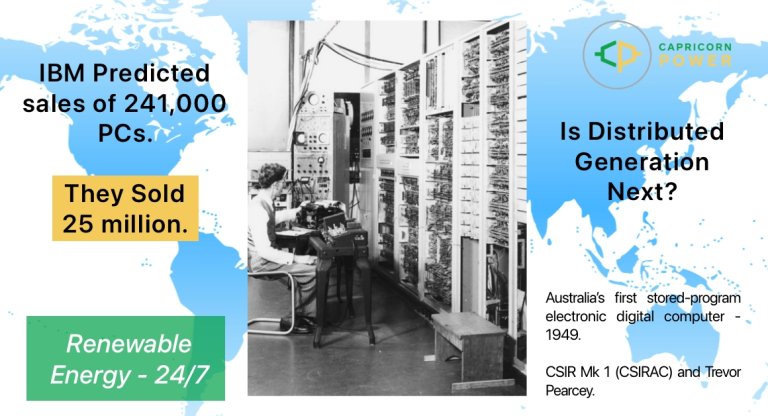
The first “computers” were teams of people doing calculations by hand, followed by mechanical calculators that sped up, but did not replace, human work. By the mid 20th century, landmark electronic machines such as ENIAC and Australia’s CSIRAC centralised computing power in a few large facilities, so organisations had to bring problems to the computer rather than computing at the point of need.
When personal computers arrived, mass production flipped that model. An internal IBM forecast famously estimated only 241,000 PCs would be sold over five years, yet the market absorbed around 25 million units in that period, more than 100 times the prediction. Experts underestimated how quickly a mass-produced, affordable, user-controlled device could displace a small number of very large, centralised systems. RETROCOMPUTING
Power is now following the same curve
Electricity in recent history, has been dominated by large, centralised power stations and long transmission lines, with customers as passive price-takers. Today, distributed generation is scaling rapidly – one global analysis valued the distributed generation market at approximately USD 246 billion in 2022 and projected it to reach roughly USD 616 billion by 2030, a compound annual growth rate of about 12 percent! Another forecast suggests distributed energy generation could grow from roughly USD 538 billion in 2025 to more than USD 720 billion by 2030, adding over USD 180 billion of new value in just five years. GLOBENEWSWIRE
This shift is driven by three forces: the need to cut emissions, the falling cost of small‑scale equipment, and customers wanting more control over reliability and price. In other words, electricity is starting to repeat the PC story – moving from a few large, central assets to millions of smart, distributed ones close to the customer. FACTMR
Where the Barton Heat Engine is different
Capricorn Power’s Barton Heat Engine converts high-temperature heat into electricity using a closed-loop Brayton-cycle efficiently, and without problematic working fluids and without water for cooling towers.
The engine is designed to operate at pressures below 20 bar using standard, lower-cost materials, which helps support future cost reduction through manufacturing scale-up.
From waste & waste heat to 24/7 renewable power
The Barton Heat Engine is designed as a distributed generator that lives at the customer site, turning local waste, waste heat or renewable heat into low-cost electricity and usable heat. Typical heat sources include biomass and green waste, flare gas from landfill and wastewater treatment, industrial waste heat, and solar-thermal collectors. CLIMATELAUNCHPAD
Because the system runs on stored or continuously available heat, it can provide firm, 24/7 renewable electricity that complements intermittent wind and solar. Remote monitoring and control allow Capricorn Power to operate and maintain assets while customers will have the option of paying for heat and power or owning the generation equipment.
Why this looks like an early stage “PC moment” for power
In the 1980s, personal computers unlocked new value by putting computing directly in the hands of users, not just in central data centres. Capricorn Power’s vision is similar for electricity: mass-produced, high-efficiency generators at customer premises, using free or low-cost heat inputs to give customers more control over their energy and costs. CAPRICORNPOWER
Investors who recognise this pattern, centralised incumbents giving way to distributed, mass-produced devices, have historically captured outsized returns when adoption inflects. With the Barton Heat Engine now moving from development to commercial deployment, and global distributed generation markets expanding by hundreds of billions of dollars this decade, the opportunity is to help shape this transition rather than just observe it. CREATEDIGITAL
Which other industries do you think are about to repeat the ‘mainframe-to-PC’ pattern, and how could distributed clean heat-to-power fit into your own operations or portfolio?
Contact us to learn more on how you can invest.